The operational lifespan and efficiency of hydropower infrastructure, particularly high-speed turbine components, are profoundly influenced by the interaction between water chemistry and material science. For ASUMB, optimizing this interplay through meticulous analysis of hydrochemical properties and judicious metallurgical selection is paramount to ensuring decades of reliable service. This section delves into the critical considerations that prevent premature degradation of expensive hydro-mechanical equipment.
1. Water Chemistry: The Unseen Force of Degradation
The composition of water flowing through a hydropower system is a dynamic and often aggressive medium. Ignoring its chemical properties can lead to rapid material failure.
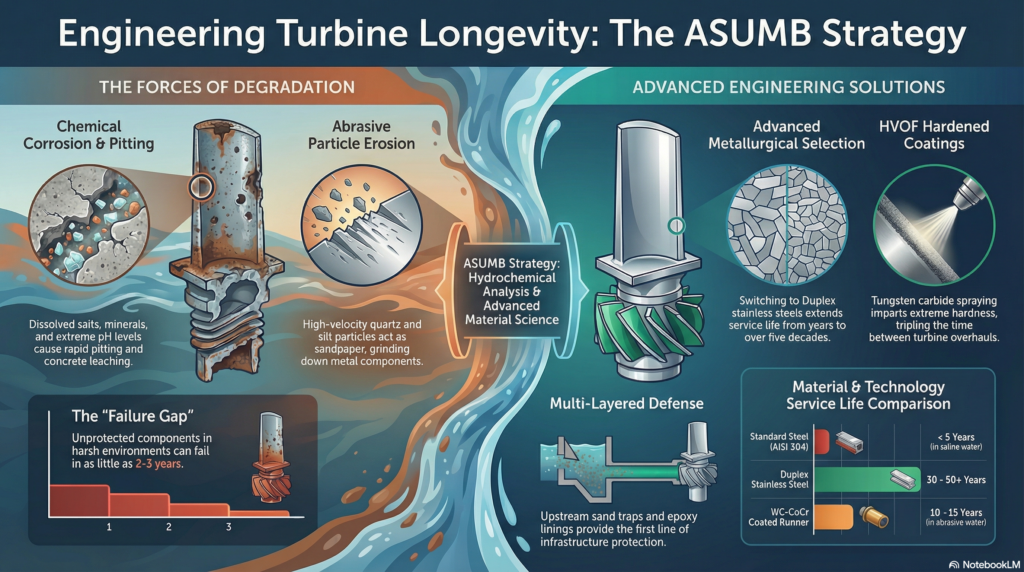
- Salinity and Mineralization: High concentrations of dissolved salts and minerals, particularly chlorides and sulfates, are potent drivers of pitting and crevice corrosion. For instance, projects utilizing saline or brackish water from coastal or endorheic basins (like some Central Asian regions) necessitate specialized materials.
- Solution: Selection of advanced stainless steels such as AISI 316L or Duplex stainless steels (e.g., Lean Duplex 2304, Super Duplex 2507). These alloys offer superior resistance to various forms of corrosion, extending the operational window and reducing maintenance costs significantly. Using AISI 304 in such environments would result in premature component failure within years, whereas Duplex can offer service life exceeding 30-50 years.
- Acidity (pH): Extreme pH values, whether acidic or alkaline, can aggressively attack both metallic components and concrete structures. Acidic waters (pH < 7) accelerate metallic corrosion and can leach calcium from concrete, weakening its matrix.
- Solution: Beyond material selection, this involves protective coatings (e.g., epoxy-based linings for concrete surfaces, specialized paints for exposed metalwork) and, in some rare cases, pre-treatment strategies if economically viable. Regular monitoring of pH levels allows for timely intervention.
- Dissolved Gases: Oxygen, carbon dioxide, and hydrogen sulfide (H₂S) can contribute to localized corrosion, stress corrosion cracking, and hydrogen embrittlement, particularly in confined spaces or stagnant areas.
2. Abrasive Wear: Battling the Solid Particles
Natural river systems frequently carry suspended solids, ranging from fine silt to coarse sand. These particles, propelled at high velocities through turbine runners and waterways, cause severe abrasive erosion.
- Particle Analysis: Detailed analysis of sediment concentration, particle size distribution, and mineral hardness (e.g., quartz content) is fundamental during the feasibility and design phases.
- Example: In rivers originating from glaciated mountains, like those feeding many Central Asian or Himalayan projects, high concentrations of quartz-rich sand are common, demanding extreme wear resistance.
- Mitigation Strategies:
- Design Optimization: Sand traps and desilting basins upstream of the power intake are the first line of defense, reducing the load of abrasive particles entering the system.
- Material Hardening: For critical components like turbine runners, guide vanes, and wear rings, standard stainless steels are insufficient.
- Solution: Application of abrasion-resistant coatings is vital. Technologies include High-Velocity Oxygen Fuel (HVOF) spraying of tungsten carbide (WC-CoCr) or chromium carbide (Cr3C2-NiCr) alloys. These coatings impart hardness far exceeding that of base metals, significantly extending the time between overhauls and reducing costly downtime. For example, a bare steel runner in highly abrasive water might erode significantly in 2-3 years, while a WC-CoCr coated runner can last 10-15 years or more.
- Benefit: This drastically reduces the frequency of component replacement and associated logistical challenges, especially in remote project locations.
3. Metallurgical Selection: The Right Material for the Challenge
The «Hydrochemistry and Metallurgy» block is where ASUMB’s expertise translates into tangible benefits: reduced maintenance, increased efficiency, and extended plant life.
- Cost-Benefit Analysis: While advanced materials and coatings have higher upfront costs, their long-term economic benefits (reduced downtime, lower repair costs, optimized energy production) far outweigh the initial investment.
- Integrated Approach: Our team combines hydrochemical testing, materials science expertise, and computational fluid dynamics (CFD) to predict wear patterns and select optimal materials.
Conclusion
Understanding and strategically addressing the challenges posed by water chemistry and abrasive wear is not merely a design consideration but a cornerstone of sustainable hydropower development. By integrating advanced metallurgical solutions with comprehensive hydrochemical analyses, ASUMB ensures that our hydropower projects are built to endure, delivering clean energy reliably for generations.