
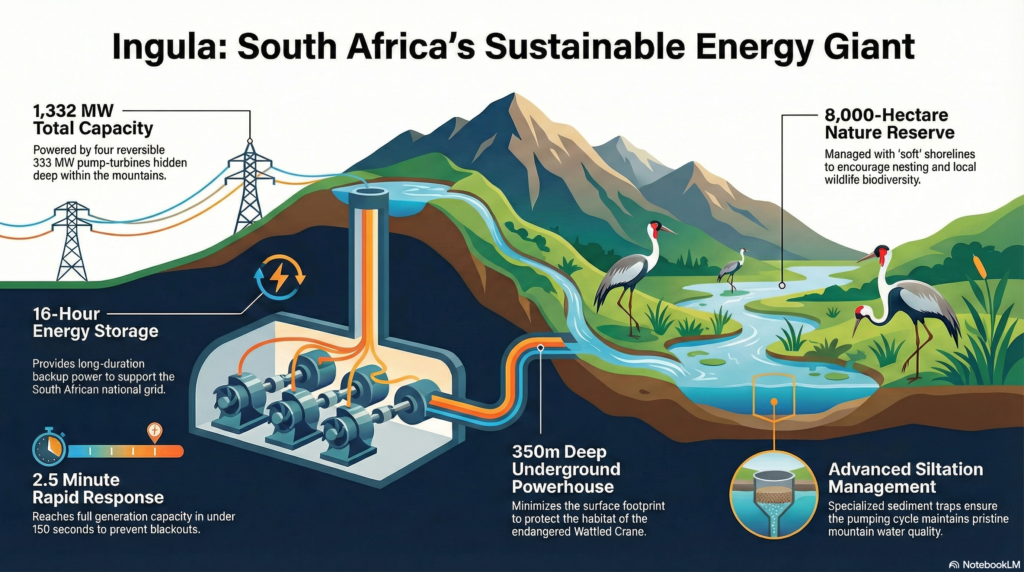

Eco-Friendly Storage: How Ingula PSH Coexists with Nature

Engineering for Biodiversity

The Ingula Pumped Storage Scheme, located on the border of the Free State and KwaZulu-Natal provinces, is a masterpiece of sustainable engineering. With a capacity of 1,332 MW, it is South Africa’s most advanced energy asset. At Hydro News, we explore how engineers protected high-altitude wetlands and rare bird species while building this massive underground power station.

1. Technical Specifications: Hidden Power

To minimize the surface footprint, almost all technical components are hidden deep inside the Little Drakensberg mountains.

  • Total Capacity: 1,332 MW.
  • The Units: 4 reversible pump-turbines (333 MW each).
  • Construction Timeline: 11 years (2005–2016).
  • Max Head: 480 meters.
  • Storage Duration: The plant can generate full power for 16 hours, providing critical backup for the South African grid.

2. Environmental Engineering: The «Green» Blueprint

Ingula is situated in a 8,000-hectare nature reserve. To coexist with nature, several technical innovations were implemented:

  • Underground Powerhouse: The entire machine hall is 350 meters underground, leaving the surface landscape undisturbed for endangered birds like the Wattled Crane.
  • Siltation Management: Special sediment traps were built to ensure that the pumping cycle does not muddy the pristine mountain water, preserving the local aquatic ecosystem.
  • Buffer Zones: The reservoirs (Bedford and Braamhoek) are managed with «soft» shorelines to encourage nesting for local wildlife.

3. Operational Excellence

  • Grid Stabilizer: Ingula can reach full capacity in under 2.5 minutes, making it the primary defense against blackouts for the Eskom utility.
  • Technical Lifespan: Designed for a 50-year service life with digital monitoring systems that track both structural integrity and local water quality in real-time.

Conclusion: A New Era for Hydro

Ingula proves that large-scale energy storage does not have to destroy the environment. Ultimately, the lessons learned in South Africa show that with the right engineering mindset, we can build the world’s greenest «batteries» in the most delicate ecosystems.

Submit details. Get custom technical calculations.

Submit your project details, and our engineering team will provide a comprehensive technical calculation. We analyze head, flow, and site conditions to ensure maximum efficiency for your future plant.

1taraza ii, colombia, 2024
Resource Center

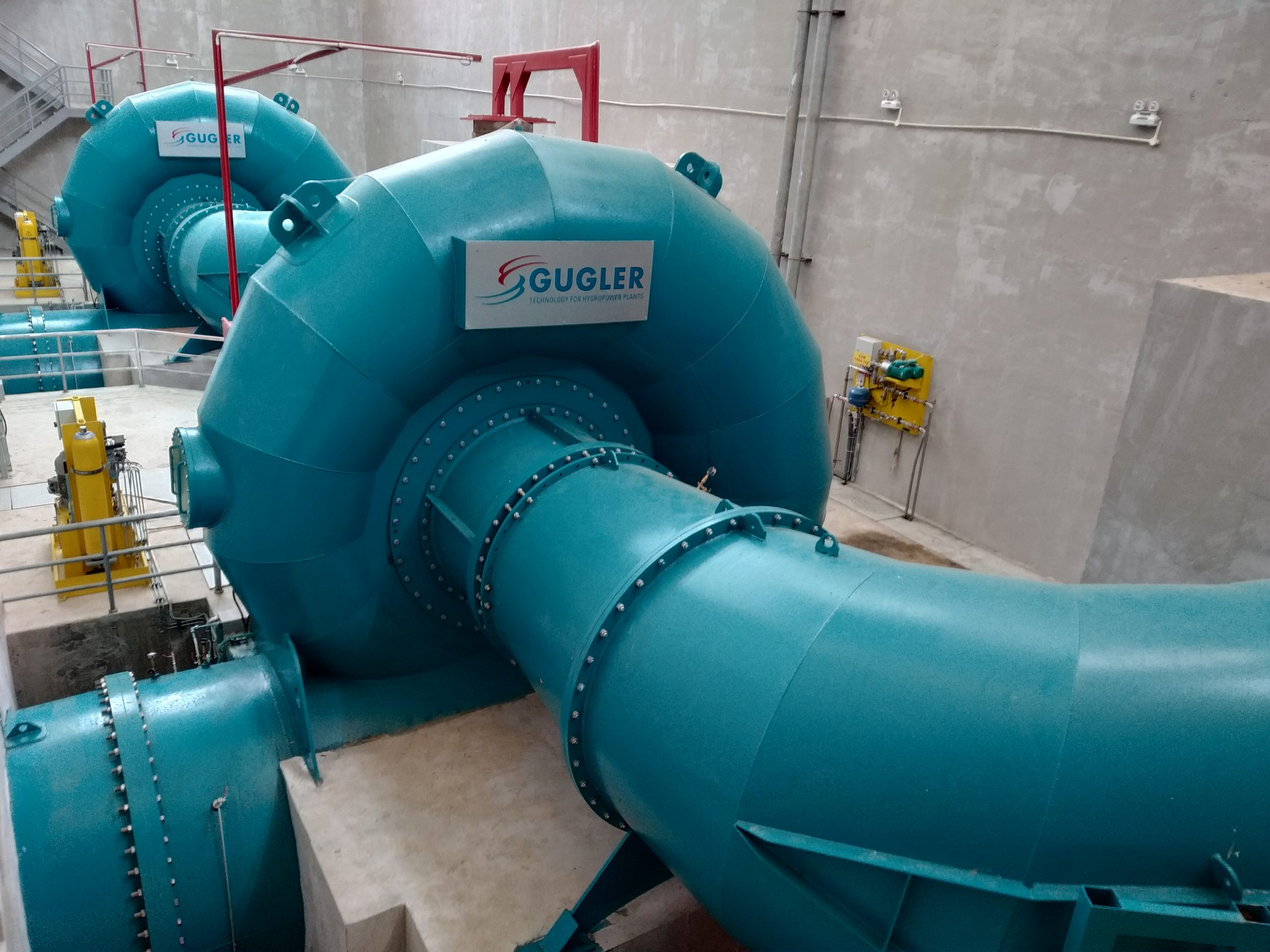
The Big Three: Choosing the Right Hydro Turbine

The Heart of the Plant Choosing the correct turbine is the most critical decision in hydropower engineering. The choice depends entirely on two factors: Head ...
Read More →
1bach dang, vietnam, 2021
Resource Center

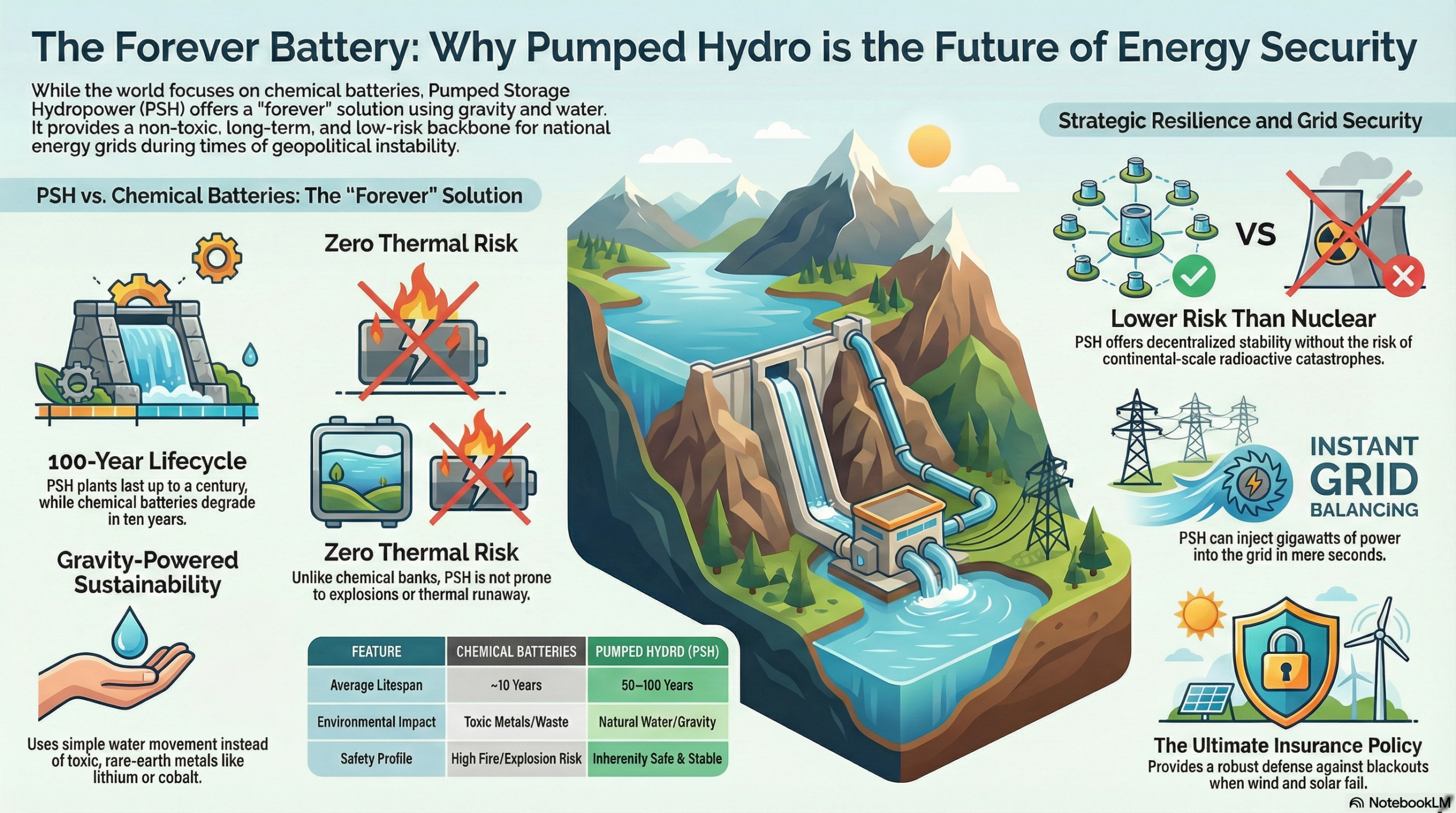
The Gravity Battery: Why Pumped Hydro is the Only Sovereign Solution for Global Energy Security

Оставьте комментарий / Editors Pick, Stock Market / От asumb The Gravity Battery: Why Pumped Hydro is the Only Sovereign Solution for Global Energy Security The Battery Myth vs. Natural ...
Read More →
Classic Hydro

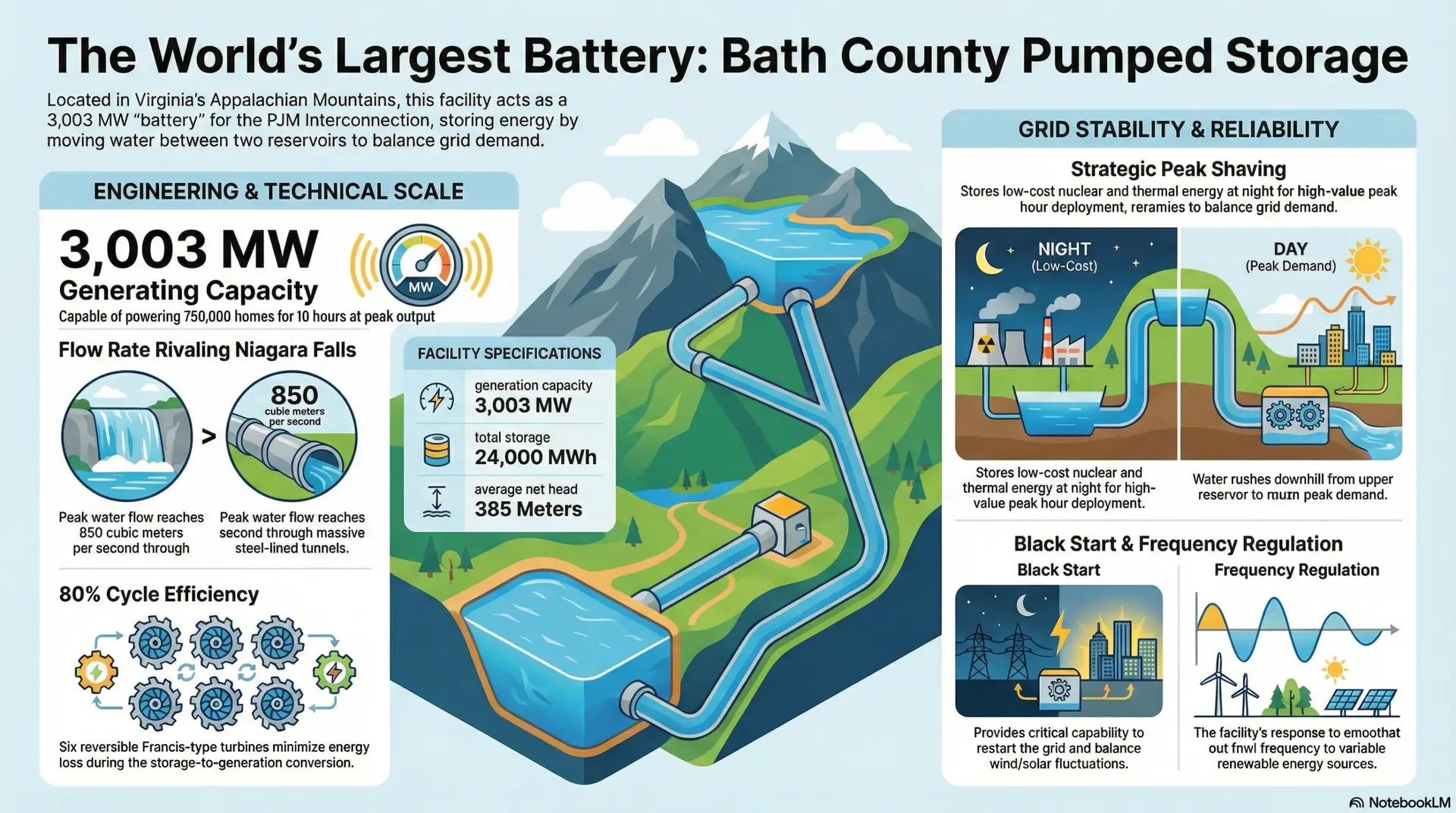
Why Pumped Storage Hydropower is the Ultimate Energy Security Solution

Discover why PSH is the only reliable «gravity battery» for grid stability. Learn why chemical batteries and nuclear risks can’t match the safety and scale ...
Read More →
Land & Sites

The Giant of Storage: Technical Overview of Bath County PSH

IThe Bath County Pumped Storage Station is a true engineering marvel. It is located in Virginia, USA. Many experts call it the «World’s Largest Battery.» ...
Read More →
Classic Hydro

Site Integrity in Pumped Storage Hydropower: The Foundation of Geological and Geodetic Surveys

The viability of a Pumped Storage Hydropower (PSH) project depends entirely on the structural integrity of the site. Before a single cubic meter of concrete ...
Read More →
Portfolio

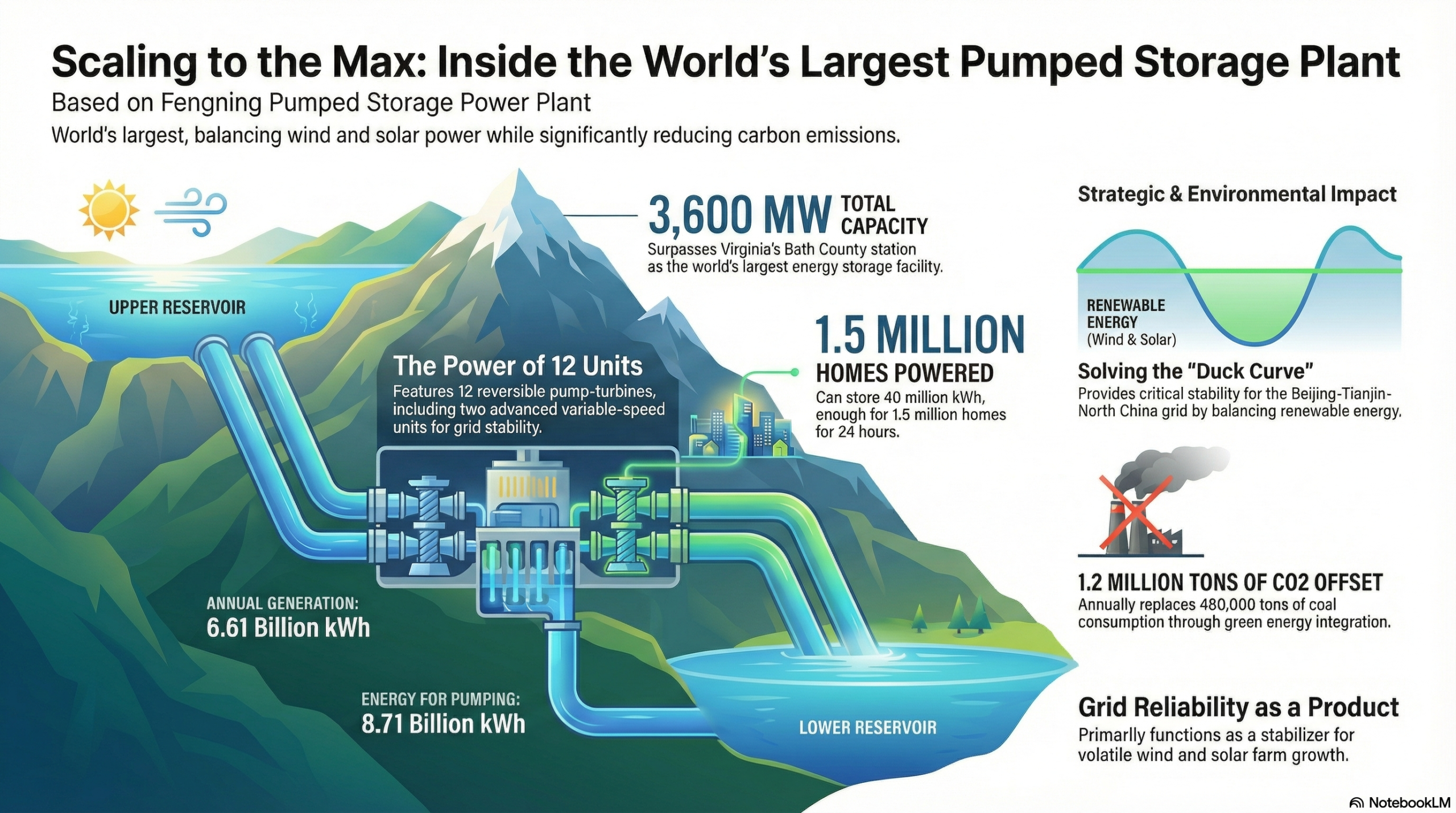
Scaling to the Max: Lessons from the World’s Largest PSH Plant in China

The Apex of Pumped Storage The Fengning Pumped Storage Power Plant in Hebei Province is a record-breaking achievement. With a total capacity of 3,600 MW ...
Read More →

HydroNews