
The Enemy Within
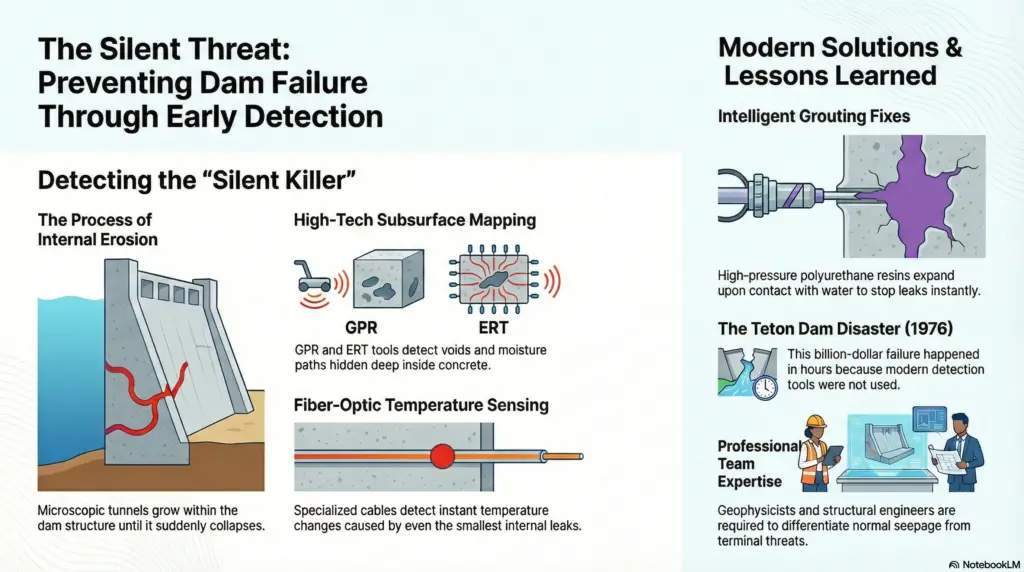
Internal erosion is the leading cause of embankment dam failures worldwide. Specifically, water begins to create microscopic tunnels through the structure. Consequently, these small «pipes» grow until the dam collapses. At asumb, we prioritize early detection using advanced diagnostic equipment to prevent these silent disasters.
1. High-Tech Detection: Seeing Through Concrete and Soil
You cannot find internal erosion with a simple visual inspection. Therefore, we use specialized tools to «see» inside the dam.
- Ground Penetrating Radar (GPR): This device sends high-frequency radio waves into the structure. Specifically, it detects voids and water-filled pockets that indicate erosion.
- Fiber-Optic Temperature Sensing: We install cables along the dam’s core. Consequently, even a tiny leak causes a temperature change that the sensors detect instantly.
- Electrical Resistivity Tomography (ERT): This method maps the moisture levels inside the dam. As a result, we identify «seepage paths» long before they become visible on the surface.
2. Required Skills and Expertise
Detecting erosion requires more than just equipment. First, you need geophysicists to interpret complex radar data. Second, structural engineers must calculate the remaining strength of the eroded zone. Finally, specialized divers or ROV (Remotely Operated Vehicle) pilots are needed to inspect underwater intakes. Clearly, only a professional team can differentiate between normal seepage and a terminal threat.
3. Fixing the Leak: Modern Grouting Techniques
Once we find the erosion, we must act immediately. Instead of rebuilding the dam, we use «Intelligent Grouting.»
- Polyurethane Injection: We inject high-pressure resins that expand upon contact with water. Specifically, this material fills the void and stops the leak in seconds.
- Bentonite Slurry Walls: For larger internal erosion, we create a waterproof barrier inside the dam. Thus, the structure is reinforced without stopping the station’s operation.
4. Real-World Failure Example: Teton Dam (USA)
The Teton Dam disaster is a tragic lesson in undetected erosion. In 1976, internal «piping» began in the right abutment. Because the engineers lacked modern fiber-optic monitoring, the leak grew rapidly. As a result, the dam failed in just a few hours. Clearly, modern GPR and ERT tools could have saved this billion-dollar asset.
Conclusion: Prevention is Cheaper than Disaster
Erosion does not stop on its own. Clearly, it only accelerates. By investing in early detection equipment and professional audits, you protect your capital and the lives of people downstream. Ultimately, a safe dam is the only dam that produces long-term profit.
Submit details. Get custom technical calculations.
Submit your project details, and our engineering team will provide a comprehensive technical calculation. We analyze head, flow, and site conditions to ensure maximum efficiency for your future plant.